How to Read Vape Reviews: A Buyer's Guide

How to Read Vape Reviews: A Buyer’s Guide
Reading vape reviews is the essential skill for making informed, safe, and satisfying purchases on disposable vapes like Geek Bar. Most buyers skim star ratings and move on. That approach misses the details that actually matter: nicotine strength, batch documentation, third-party lab results, and the red flags that separate a trustworthy product from a counterfeit one. This guide gives you a practical framework for interpreting vape product reviews so every purchase you make is backed by real evidence, not marketing copy.
How to read vape reviews: what to look for first
The most useful vape reviews go beyond flavor opinions. They reference specific product details that you can verify independently. Knowing what to look for turns a review from entertainment into a research tool.
Start with these core details in any review or product listing:
- Nicotine strength: Labels display nicotine strength in mg/mL alongside safety icons and manufacturer contact information. A review that mentions “5mg/mL” tells you far more than one that says “strong hit.”
- Flavor accuracy: Does the reviewer describe the flavor in specific terms, like “bright citrus with a clean finish,” or just say “tastes good”? Specific descriptions signal a genuine experience.
- Battery and puff count: For disposables like Geek Bar, battery life determines whether the device lasts as advertised. Reviews that mention actual puff counts versus stated puff counts are the most useful.
- Batch numbers and manufacturer info: Missing batch info or manufacturer contacts are major red flags. A legitimate product lists both clearly on the packaging.
- Lab testing mentions: Reviews or product pages that reference Certificates of Analysis (COAs) or QR codes linking to lab results signal a higher standard of transparency.
Pro Tip: Check the vape terminology guide at Cloud District before reading technical reviews. Knowing terms like “LOQ,” “COA,” and “TPD compliance” lets you extract far more value from what reviewers write.
Nicotine strength directly affects your experience and tolerance. Beginners benefit from lower mg/mL levels to avoid overconsumption. A review that skips this detail entirely is incomplete, regardless of how many stars it carries.

How do you spot trustworthy vape reviews?
Not every review reflects a real purchase. Fake and manipulated feedback is common in the disposable vape market, and learning to identify it protects your money and your health.
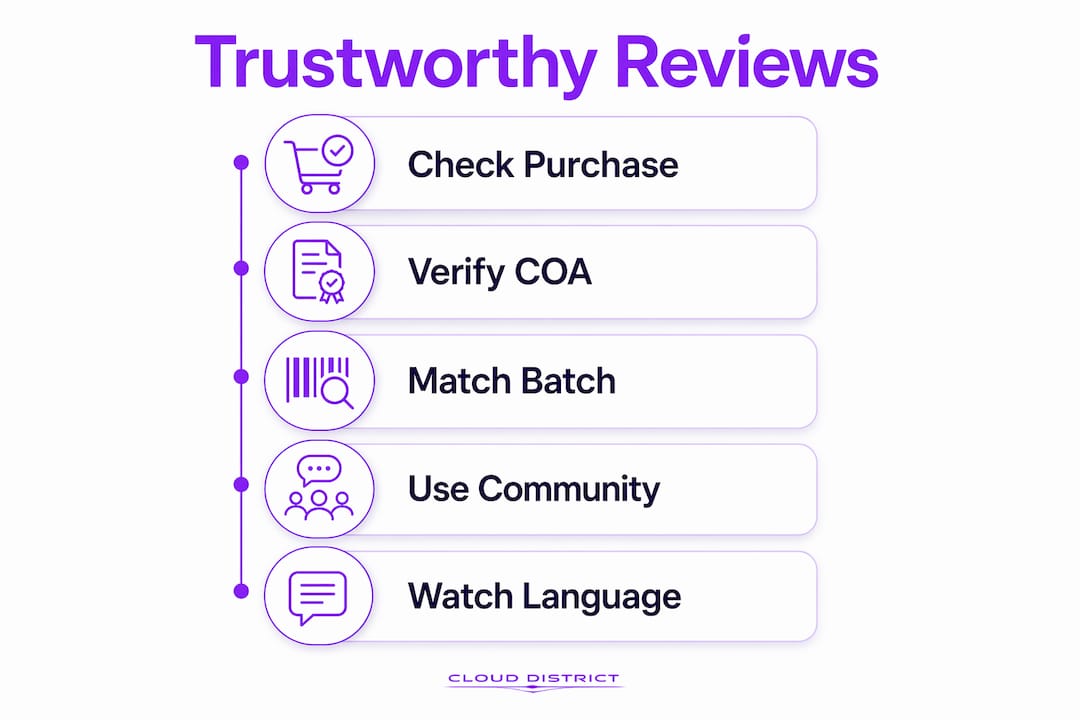
Authentic reviews share a consistent pattern. They include both positives and minor criticisms. A reviewer who loved the Geek Bar Pulse but noted the draw was slightly tight is far more credible than one who calls it “perfect in every way.” Balanced feedback with flavor, battery life, and ease of use details gives you a realistic picture of what to expect.
Watch for these warning signs of fake or manipulated reviews:
- Sudden floods of five-star ratings: Dozens of generic five-star reviews posted in a short timeframe are a manipulation signal.
- Repeated phrases: If multiple reviews use identical language like “absolutely love this product,” they likely share a source.
- Zero negatives: No product is flawless. A review page with no complaints at all is suspicious.
- Vague descriptions: “Great taste, will buy again” tells you nothing. Authentic reviewers describe specifics.
Community platforms like Reddit offer a different kind of signal. Subreddits focused on vaping tend to produce candid, detailed feedback because users have no financial stake in the outcome. Cross-referencing Reddit threads with retailer reviews gives you a fuller picture. When the community consensus matches the product page ratings, that alignment is a strong trust indicator.
What is a COA and why does it matter in vape reviews?
A Certificate of Analysis (COA) is a lab document that verifies what is actually inside a vape product. Third-party lab tests and COAs provide transparency that protects consumers by confirming product claims and safety. Any review or product listing that references a COA is giving you something you can verify yourself.
What a COA contains
A complete COA includes the test date, the accredited lab’s name, potency details, and contaminant testing results. A clear COA shows pass/fail results for residual solvents, heavy metals, pesticides, and microbial contaminants. Each analyte lists a limit of detection (LOD) or limit of quantification (LOQ), which tells you how sensitive the test was.
| COA Element | What to Check |
|---|---|
| Test date | Should be recent, within the last 12 months |
| Lab name | Must be an accredited, independent third-party lab |
| Batch/lot number | Must match the number printed on your packaging |
| Potency results | Confirms nicotine or active ingredient levels |
| Contaminant panel | Look for “Pass” on solvents, metals, pesticides, and microbes |
How to match batch numbers
Batch numbers on packaging must match those on the COA to confirm the lab results apply to your specific product. A mismatch means the report does not verify what you are holding. This is the single most overlooked check among new buyers. If a review links to a COA but does not mention batch verification, treat the citation as incomplete.
Pro Tip: Scan the QR code on the packaging before you vape. Brands that link directly to batch-specific COAs via QR code are demonstrating the highest level of product transparency available in 2026.
Batch-specific documentation is a critical safety check that goes beyond brand reputation. A brand can have an excellent reputation and still ship a bad batch. The COA is your confirmation that this specific unit passed testing.
How to compare vape reviews to make a buying decision
Comparing reviews across multiple sources gives you a cleaner signal than relying on any single platform. The goal is to build a short comparison of the factors that actually affect your experience.
Follow these steps when evaluating disposable vapes like Geek Bar:
- Gather at least three sources. Use a retailer review page, a community platform like Reddit, and a dedicated vape review site. Each source attracts a different type of reviewer.
- Build a comparison table. Track flavor accuracy, puff count versus advertised count, battery consistency, price per unit, and whether the brand provides COA access.
- Check for brand transparency. Does the brand list a manufacturer address? Do product pages link to lab results? Brands that provide accessible lab testing results and QR code scanning linked to COAs are generally more trustworthy.
- Weigh negative reviews more heavily. One detailed negative review describing a specific failure, like a leaking pod or a burnt taste after 200 puffs, carries more predictive weight than ten generic positives.
- Confirm regulatory compliance. Reviews that mention TPD compliance, nicotine warnings, or childproof packaging confirm the product meets legal safety standards. The Cloud District buyer’s guide covers what compliance markers to look for on product pages.
The most common mistake buyers make is treating price as the primary filter. A cheaper disposable with no COA access and vague labeling costs more in the long run, either in a poor experience or a safety risk. Prioritize transparency over price when the gap is small.
Key Takeaways
Reading vape reviews effectively requires verifying product details, lab documentation, and review authenticity before making any purchase decision.
| Point | Details |
|---|---|
| Check product label details | Look for nicotine mg/mL, batch numbers, and manufacturer contact info in every review. |
| Verify COA batch numbers | Match the batch number on packaging to the COA to confirm lab results apply to your unit. |
| Spot fake reviews | Avoid products with sudden floods of generic five-star ratings and zero critical feedback. |
| Use multiple review sources | Cross-reference retailer pages, Reddit, and dedicated vape review sites for a balanced view. |
| Prioritize lab transparency | Choose brands that provide QR code access to batch-specific third-party lab results. |
What I’ve learned after years of reading vape reviews
Most buyers focus on flavor and price. Both matter. But after spending years reading vape reviews and watching the disposable market grow, the detail that separates a confident purchase from a regrettable one is almost always documentation.
New enthusiasts make the same mistake repeatedly: they trust a brand’s overall reputation instead of verifying the specific batch. A brand can have years of positive reviews and still release a batch with inconsistent nicotine levels or a failed contaminant test. The COA for your batch is the only document that confirms your unit is what the label claims.
The second mistake is over-relying on a single platform. Retailer review pages have an obvious incentive to surface positive feedback. Reddit threads, by contrast, tend to surface the edge cases: the device that died at 300 puffs, the flavor that tasted nothing like the description, the batch that smelled off. Those edge cases are the most useful data points you can find.
My honest recommendation is to treat any review that skips batch documentation as incomplete. It might still be useful for flavor impressions or draw resistance. But for safety and authenticity, batch-specific COA verification is non-negotiable. The counterfeit vape risks are real and well-documented. Reading reviews the right way is your first line of defense.
— Justin
Cloud District’s verified disposable vape selection
Cloud District carries a curated selection of disposable vapes with transparent product pages, including batch information and lab documentation where available. For buyers who have done the research and know what to look for, the catalog makes it straightforward to find products that meet a high standard.

The Pulse Strawberry Kiwi Thermal Edition and RIA Sour Strawberry Dragon are two options with detailed product specs and flavor profiles that match what reviewers describe. Cloud District’s rewards program, Cloudz, adds value on every purchase. Verified buyers can also take advantage of exclusive deals on top disposable brands through the platform.
FAQ
What does a COA tell you about a vape product?
A COA confirms potency levels and shows pass/fail results for contaminants including residual solvents, heavy metals, pesticides, and microbes. It is the primary document for verifying that a vape product matches its label claims.
How do you know if a vape review is fake?
Fake reviews typically appear in large numbers over a short period, use repeated generic phrases, and contain no critical feedback. Authentic reviews describe specific details like flavor accuracy, puff count, and draw resistance.
Why does the batch number matter when reading vape reviews?
The batch number on your packaging must match the batch number on the COA. A mismatch means the lab results do not apply to your specific product, which removes the safety verification entirely.
What nicotine strength should I look for in reviews?
Reviews that specify nicotine strength in mg/mL are the most useful. Beginners should look for lower mg/mL options to avoid overconsumption, while experienced users can use reviewer comparisons to gauge whether a product matches their tolerance.
Where are the most reliable vape reviews found?
The most reliable vape reviews come from cross-referencing retailer pages, Reddit communities, and dedicated vape review sites. No single source gives the full picture; alignment across multiple platforms is the strongest trust signal.