Vape Compliance for Retailers: 2026 Guide

Vape Compliance for Retailers: 2026 Guide
Vape compliance is defined as the act of meeting all legal and regulatory requirements that govern the manufacture, distribution, sale, labeling, and marketing of vaping products within a given jurisdiction. For vape retailers and industry professionals, this means navigating a web of federal mandates, state laws, product authorization rules, and enforcement actions that carry real legal consequences. The regulatory bodies shaping this space include the U.S. Food and Drug Administration, the Department of Justice, and the UK’s Trading Standards. Understanding vape compliance basics is no longer optional. It is a condition of operating legally in this industry.
What is vape compliance under U.S. federal law?
U.S. vape compliance centers on FDA marketing authorization. As of may 2026, only 45 e-cigarette products have received FDA marketing authorization for lawful sale in the United States. That number is strikingly small relative to the thousands of products currently on the market. Every product sold without authorization is technically illegal under the Federal Food, Drug, and Cosmetic Act.
The FDA’s authorization process requires manufacturers to submit a Premarket Tobacco Product Application demonstrating that their product is appropriate for the protection of public health. Authorization does not mean FDA approval in the clinical sense. It means the FDA has reviewed the product and determined it may be legally marketed. Retailers must verify every product they stock against the FDA’s publicly available tobacco products database.

The PACT Act adds another compliance layer for remote sellers. Under the PACT Act, remote sellers of vaping products must register with the state Attorney General, collect and remit applicable taxes, verify buyer age, and comply with carrier shipping restrictions. These obligations apply to any retailer selling vapes online or by mail, regardless of business size. Failure to comply exposes sellers to both federal and state enforcement.
Key U.S. compliance requirements for vape retailers:
- Verify all inventory against the FDA’s authorized e-cigarette product list before purchasing from any supplier
- Register with the relevant state Attorney General if selling remotely under PACT Act rules
- Implement age verification at point of sale and for all online transactions
- Collect and remit state excise taxes on vaping products as required by each jurisdiction
- Maintain records of supplier documentation, purchase orders, and authorization status for all products
- Train staff to identify unauthorized products and understand inspection protocols
Pro Tip: Cross-reference your entire product catalog against the FDA database at least once per quarter. Authorization status can change, and holding a product that loses authorization creates immediate legal exposure.
Supply chain liability is a critical and often misunderstood element of U.S. vape compliance. Retailers can be held liable under the FDCA for stocking unauthorized vaping products even if they had no knowledge of the supplier’s non-compliant status. Ignorance is not a legal defense. This means supplier due diligence is not optional. Retailers must independently verify authorization status rather than relying on a distributor’s word.
How do vape regulations differ internationally?
The UK enacted the Tobacco and Vapes Act in april 2026, creating one of the most sweeping vaping regulatory frameworks in the world. The Act introduces mandatory retail licensing for vape sellers, a phased tobacco purchase ban for anyone born after january 1, 2009, and strict rules on disposable vape products. UK enforcement relies heavily on local Trading Standards officers, whose capacity and resources directly determine how consistently the law is applied across regions.
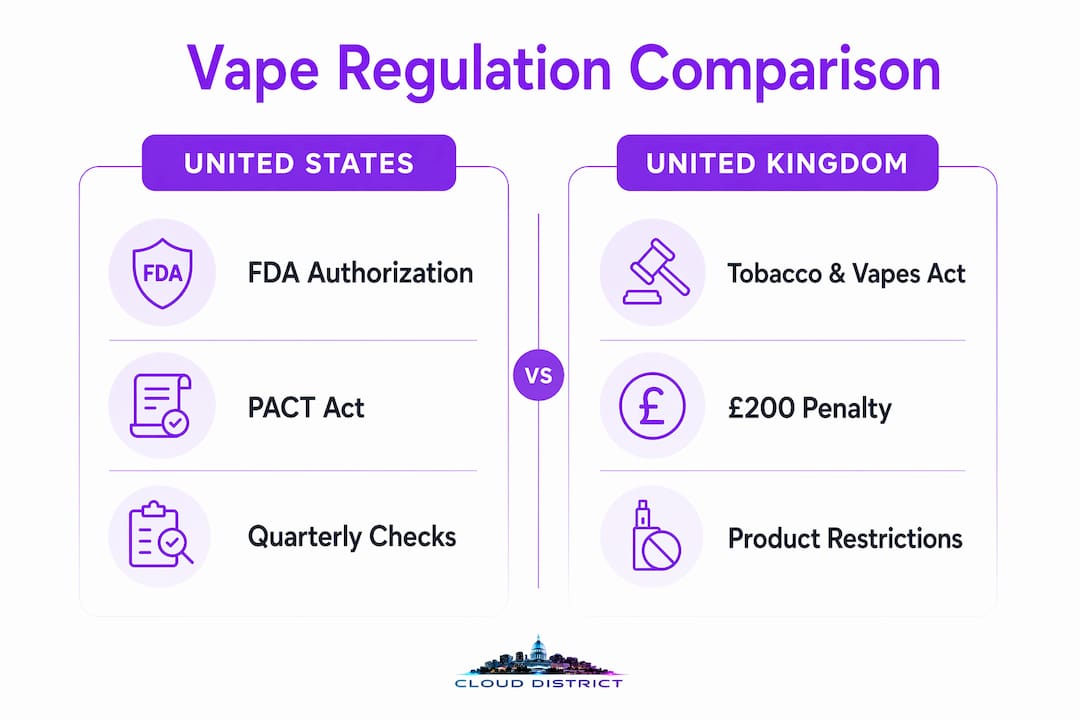
Penalties under the UK framework are significant. Selling banned disposable vapes carries a £200 fixed penalty or up to two years imprisonment for serious offenses. That combination of financial and criminal penalties signals that the UK treats vape non-compliance as a public health enforcement priority, not a minor administrative matter.
The following table summarizes key regulatory differences between the U.S. and UK frameworks:
| Requirement | United States | United Kingdom |
|---|---|---|
| Product authorization | FDA marketing authorization required | Retail licensing required under 2026 Act |
| Age restriction | 21 years or older | 18 years or older; generational ban for post-2009 births |
| Remote sales rules | PACT Act registration, tax, and age verification | Strict advertising and online sale restrictions |
| Disposable vape rules | Unauthorized products banned; limited authorized list | Banned disposable vapes carry fines and imprisonment |
| Enforcement body | FDA, DOJ, state attorneys general | Local Trading Standards officers |
Beyond the U.S. and UK, legal frameworks can shift without warning. A 2026 Malaysian court decision banned nicotine vape sales overnight, demonstrating that judicial rulings can overturn established regulatory frameworks with no transition period. Businesses operating in multiple jurisdictions must treat legal stability as a variable, not a given. Compliance programs need to account for sudden changes, not just current rules.
What steps can vape retailers take to maintain compliance?
Practical compliance for vape shops requires a structured, repeatable process rather than a one-time review. The following steps represent the minimum standard for retailers operating in 2026.
- Audit your inventory against the FDA authorized list. Pull the current FDA database and compare every SKU you stock. Remove any product not on the list immediately. Repeat this process quarterly and after any new supplier onboarding.
- Conduct supplier due diligence before placing orders. Request written documentation of authorization status from every supplier. Verify their claims independently using official FDA records. Do not accept verbal assurances or marketing materials as proof.
- Implement age verification at every sales point. Age verification applies to in-store sales, online transactions, and any delivery service. Review your age verification practices to confirm they meet both federal and state standards. Document every verification process.
- Train employees on compliance protocols. Staff must know how to identify unauthorized products, handle inspection requests, and escalate compliance concerns. Training records should be maintained and updated whenever regulations change.
- Diversify your sales channels. Platform bans represent a real and growing risk. Shopify banned all vape sales in june 2026 following pressure from state attorneys general. Retailers who relied solely on Shopify lost their primary sales channel overnight. Operating across multiple platforms and maintaining a direct ordering option protects business continuity.
- Monitor state-level regulatory changes. Federal law sets the floor, but states add requirements on top. Track changes in your operating states for excise tax updates, licensing requirements, and shipping restrictions. Review your supply chain responsibilities regularly.
Pro Tip: Build a compliance calendar with quarterly FDA database checks, annual staff training reviews, and monthly monitoring of state legislative updates. Reactive compliance is far more expensive than proactive compliance.
What are the consequences of vape non-compliance in 2026?
Enforcement against unauthorized vape sales has intensified significantly. Since fiscal year 2022, the DOJ has initiated 88 enforcement actions against unauthorized e-cigarette sellers. In october 2024 alone, federal authorities seized 3 million illegal devices in a single operation. These numbers reflect a sustained, coordinated enforcement strategy rather than isolated incidents.
The consequences of non-compliance fall into several categories:
- Civil penalties: Product seizure, injunctions, and financial fines under the FDCA
- Criminal penalties: Prosecution for knowing violations, with potential imprisonment
- Business disruption: Loss of inventory, forced closure during investigations, and reputational damage
- Platform removal: E-commerce bans that eliminate digital sales channels with no appeal process
- State-level action: State attorneys general can pursue independent enforcement actions that compound federal penalties
Retailer liability extends through the entire supply chain. Enforcement has evolved from focusing primarily on manufacturers to targeting distributors and retailers directly. Holding unauthorized products is a violation regardless of how they entered your inventory.
Retailers cannot outsource their compliance obligation to suppliers. The legal responsibility for every product on your shelf belongs to you.
State laws amplify federal enforcement. The PACT Act works in conjunction with state excise tax laws and shipping restrictions, meaning a single non-compliant online sale can trigger violations at both the federal and state level simultaneously. The financial exposure from stacked penalties can be business-ending for smaller retailers.
Key Takeaways
Vape compliance requires active, documented adherence to FDA authorization requirements, PACT Act obligations, and state-level regulations, with full supply chain liability resting on the retailer.
| Point | Details |
|---|---|
| FDA authorization is mandatory | Only 45 products hold FDA marketing authorization; all others are illegal to sell. |
| Retailer liability is absolute | Stocking unauthorized products violates federal law regardless of supplier claims or intent. |
| PACT Act governs remote sales | Online and mail-order sellers must register, verify age, and remit taxes under federal law. |
| International rules vary sharply | UK penalties include imprisonment; judicial rulings can change legal status overnight. |
| Platform bans are a real risk | Shopify’s 2026 ban shows that digital sales channels can disappear without warning. |
The compliance burden falls on retailers, not just manufacturers
Working closely with the vape industry over the past several years, the shift I have watched most closely is the enforcement pivot from manufacturers to the full supply chain. Retailers used to assume that if a distributor sold them a product, the legal risk sat upstream. That assumption is now demonstrably wrong.
The Mayer Brown analysis of recent DOJ and FDA actions makes this clear. Enforcement now targets retailers directly, and the legal standard is strict liability. You held the product. That is enough. The practical implication is that every retailer needs to treat their own compliance program as a core business function, not an administrative afterthought.
What I find most underestimated is the risk of sudden legal change. The Malaysian court ruling in 2026 is not an outlier. It is a preview of what can happen in any jurisdiction when a legal challenge succeeds or a regulatory framework is overturned. Retailers who built their entire business around a single platform or a single product category learned this the hard way when Shopify exited the vape market. Diversification is not just a growth strategy. It is a compliance strategy.
The retailers who will navigate 2026 and beyond successfully are the ones treating compliance as a living program. That means quarterly audits, documented supplier checks, trained staff, and a clear plan for what happens when the rules change overnight.
— Justin
Cloud District and compliant vape product sourcing
Sourcing products from a trusted marketplace is one of the most direct ways to reduce compliance risk. Cloud District carries a curated selection of high-quality vaping products designed for retailers who need confidence in their inventory.
Cloud District’s catalog includes products like the Pulse Strawberry Kiwi Thermal Edition, giving retailers access to quality disposable options through a platform built for speed and reliability. The ordering process is direct, the product selection is curated, and the Cloudz rewards system adds value on every purchase. For retailers who need to maintain legal, high-quality inventory without the guesswork of unverified suppliers, Cloud District provides a clear path to compliant sourcing.
FAQ
What is vape compliance in simple terms?
Vape compliance is the requirement to follow all applicable laws and regulations governing the sale, distribution, labeling, and marketing of vaping products. This includes FDA authorization requirements, age restrictions, tax obligations, and state-specific rules.
How many vape products are legally authorized for sale in the U.S.?
As of may 2026, only 45 e-cigarette products hold FDA marketing authorization for lawful sale in the United States. All other products on the market are technically unauthorized and illegal to sell.
Can a retailer be penalized for selling unauthorized vapes unknowingly?
Yes. Under the FDCA, retailers are liable for holding unauthorized vaping products regardless of whether they knew the products lacked authorization. Ignorance of a supplier’s non-compliant status is not a legal defense.
What does the PACT Act require for online vape sellers?
The PACT Act requires remote sellers to register with the state Attorney General, verify buyer age, collect and remit applicable state excise taxes, and comply with carrier shipping restrictions for all vaping product sales.
What happens if a vape retailer ignores compliance requirements?
Penalties include product seizure, civil fines, criminal prosecution, and loss of sales channels. Since fiscal year 2022, the DOJ has initiated 88 enforcement actions against unauthorized e-cigarette sellers, with 3 million devices seized in october 2024 alone.