Vape Regulations Explained: What You Need to Know

Vape Regulations Explained: What You Need to Know
Vape regulations are legal rules that govern how vaping products are manufactured, marketed, sold, and used, with the primary goal of protecting public health and preventing underage access. In the United States, the FDA serves as the central authority for these rules, while countries like the United Kingdom operate under their own frameworks, such as the Tobacco and Vapes Act 2026. Understanding vaping regulations matters whether you buy vapes for personal use or run a retail operation. The rules cover far more than a simple age check at the register. They define what products can legally exist on the market, how they must be labeled, and where they can be used.
How does the FDA explain vape regulations in the United States?
The FDA regulates the manufacture, import, packaging, labeling, advertising, promotion, sale, and distribution of Electronic Nicotine Delivery Systems, commonly called ENDS. That category includes e-cigarettes, vape pens, e-cigars, and e-pipes, along with their individual components. This means the regulation touches every part of the product chain, not just the final sale.
The components covered under FDA oversight include:
- E-liquids and nicotine solutions
- Atomizers and heating coils
- Batteries and charging hardware
- Flavorings and additives
- Software embedded in electronic devices
This level of detail matters because it closes loopholes. A retailer cannot sell an “unregulated” battery or a “custom” atomizer and claim it falls outside federal rules. Every piece of the device is subject to review.
The FDA has authorized 45 e-cigarette products after scientific evaluation as of 2026. That number is small relative to the thousands of products on the market, which means the vast majority of vaping products have not received formal authorization. Consumers purchasing unauthorized products take on unknown risk, and retailers selling them face legal exposure.
One of the most overlooked compliance points involves vape shops that mix or modify e-liquids. Shops that prepare nicotine liquids may legally qualify as manufacturers, not just retailers. That classification triggers a separate and more demanding set of obligations, including scientific submissions to the FDA. Most shop owners are unaware of this distinction until they face enforcement action.
Pro Tip: If your shop offers any custom e-liquid mixing or device modification services, consult a regulatory attorney before continuing. The manufacturer classification carries obligations that standard retailer licensing does not cover.
What are the key youth protection laws related to vaping?
The legal purchase and use age for vaping products is 21 across all 50 states in the United States, covering every device type and nicotine formulation. This federal floor was established to align vaping with tobacco purchasing age requirements. No state can set a lower minimum age, though states can and do add stricter local rules on top of the federal baseline.
The rationale for strict age limits is grounded in biology. Vaping can deliver nicotine faster than cigarettes, which increases addiction risk in adolescents whose brains are still developing. This makes early exposure particularly harmful compared to adult-onset use. Regulators treat youth access as the highest-priority enforcement target for this reason.
Key youth protection measures currently in effect include:
- Age verification at point of sale, both in-store and online
- Penalties for retailers who sell to minors, including fines and license revocation
- Flavor restrictions targeting products that appeal to younger users
- Marketing restrictions that prohibit advertising in media with significant youth audiences
Flavor regulation deserves specific attention. Flavors like fruit and candy attract younger users at disproportionate rates, which is why many jurisdictions have moved to restrict or ban flavored products. The policy goal is not to eliminate adult access entirely but to reduce the marketing appeal that draws in underage users. Adult smokers seeking harm reduction alternatives may still access regulated flavored products in certain states.
“Vape laws typically focus on public health and youth protection by limiting marketing appeal, especially flavors that attract young users, rather than outright bans for adults.” — Nature
For retailers, age verification practices are not optional procedures. They are legal requirements with direct liability consequences. A single underage sale can result in fines, suspension, or permanent loss of retail authorization.
How do vape regulations differ internationally?
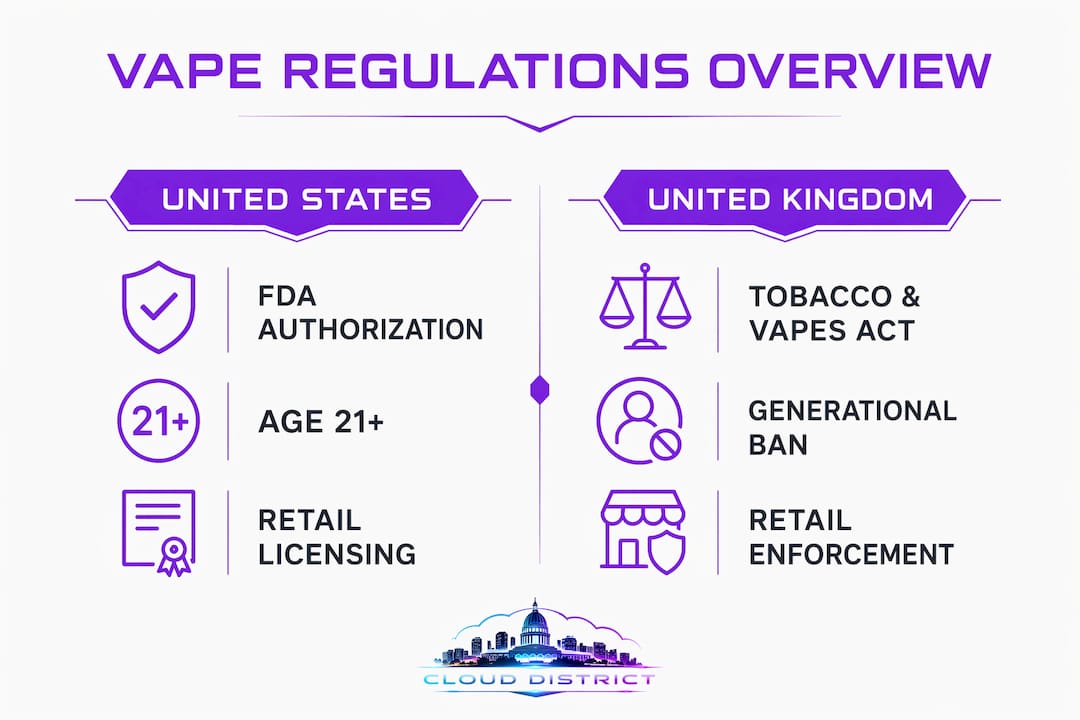
The United Kingdom passed the Tobacco and Vapes Act 2026, which takes a generational approach to eliminating tobacco and vaping uptake. The law makes it illegal to sell tobacco or vaping products to anyone born on or after January 1, 2009. As each year passes, the restricted birth year advances, meaning the minimum legal purchase age increases annually. This is a fundamentally different model from the U.S. fixed-age approach.
The table below compares the two regulatory systems across key dimensions:
| Regulatory area | United States (FDA) | United Kingdom (Tobacco and Vapes Act 2026) |
|---|---|---|
| Minimum purchase age | 21 (fixed) | Increases annually based on birth year |
| Product authorization | Scientific review required per product | Retail licensing and marketing controls |
| Flavor restrictions | State-level variation | National restrictions on packaging and flavors |
| Enforcement mechanism | FDA inspections and retailer penalties | Retail licensing with enforcement powers |
| Smoke-free locations | State and local rules | National vape-free location rules added |
The UK model prioritizes generational elimination of the habit, while the U.S. model focuses on product-level scientific authorization. Neither approach is purely permissive or purely prohibitive. Both balance adult harm reduction with youth prevention, though they use different tools to achieve that balance.
The UK’s retail licensing and enforcement powers introduced under the Act give authorities direct control over which businesses can legally sell vaping products. This is a more direct mechanism than the U.S. system, where federal product authorization and state-level retail rules operate on separate tracks. For international retailers or consumers traveling between countries, these differences create real compliance complexity.
What practical steps should consumers and retailers take to comply?
Compliance with vaping regulations requires different actions depending on whether you are a consumer or a retailer. The rules are layered, covering the product itself, the location of use, and the transaction process. Understanding each layer prevents accidental violations.
For retailers, the core compliance steps are:
- Verify age for every transaction. The legal standard is 21 years or older. Online sales require digital age verification systems, not just self-reported checkboxes.
- Stock only authorized products. Selling products without FDA authorization exposes your business to federal enforcement. Check the FDA’s authorized product list before adding new items to inventory.
- Obtain required licenses. In states and countries with retail licensing requirements, operating without a license is a criminal offense, not just a civil infraction.
- Train staff on compliance procedures. Employee errors in age verification or product handling create employer liability. Regular training is a legal protection, not just a best practice.
- Monitor regulatory updates. Vape laws change frequently at the state and local level. Subscribe to FDA updates and state health department notices to stay current.
For consumers, the primary obligations are simpler but still carry legal weight:
- Purchase only from licensed, authorized retailers. Products sold through unauthorized channels are more likely to be counterfeit or non-compliant. Counterfeit vape products carry serious health risks beyond the legal issues.
- Respect vape-free location rules. Many states, cities, and private properties prohibit vaping in the same spaces where smoking is banned. Violations carry fines.
- Confirm product authorization status. The FDA’s authorized product list is publicly available. Checking it before purchasing is a straightforward way to reduce risk.
Pro Tip: Retailers looking for compliant point-of-sale systems designed for vape and tobacco products should review purpose-built solutions like those offered by Merchant Solutions Corp, which are built to handle age verification and compliance tracking.
For consumers who want to understand the full process of ordering vapes compliantly online, Cloud District’s compliance guide covers the specific steps required under current law.
Key takeaways
Vape regulations operate as a multi-layered legal framework covering product authorization, retail licensing, age restrictions, and location-based use rules, with the FDA and the UK Tobacco and Vapes Act 2026 representing the two most detailed current models.
| Point | Details |
|---|---|
| FDA product authorization | Only 45 products have received FDA scientific authorization; selling others carries legal risk. |
| Federal age minimum | The legal purchase age is 21 across all U.S. states, with no state permitted to lower it. |
| Retailer manufacturer risk | Vape shops that mix e-liquids may qualify as manufacturers, triggering stricter FDA obligations. |
| UK generational model | The UK’s birth-year-based age increase creates a rising minimum purchase age each year. |
| Flavor restrictions | Fruit and candy flavors face restrictions because they disproportionately attract underage users. |
Why vape regulation is more complex than most people realize
I have spent time reviewing how both consumers and retailers approach vaping compliance, and the most consistent mistake I see is treating regulation as a single question: “Is this product legal?” That framing misses the point entirely.
Vape regulation is a product-level question, a transaction-level question, and a location-level question all at once. A product can be FDA-authorized, sold by a licensed retailer to a verified adult, and still be used illegally if the person vapes in a prohibited location. Each layer is independent. Failing one layer means non-compliance, regardless of how well the others are handled.
The evidence-based approach that regulators like the FDA and the UK government are moving toward is actually more nuanced than either critics or supporters tend to acknowledge. Strong regulation does not mean prohibition. It means controlled access with accountability at every point in the chain. That is a harder system to build and enforce, but it is the right framework for a product category with genuine adult harm-reduction value and genuine youth risk.
My practical advice: treat compliance as a permanent operational function, not a one-time setup task. The rules will keep changing. The retailers and consumers who stay ahead of those changes are the ones who avoid enforcement problems and make better purchasing decisions.
— Justin
Shop compliant vape products at Cloud District
Cloud District carries a curated selection of quality-checked vaping products and maintains strict age verification protocols on every transaction. Every purchase requires confirmation that you are 21 years or older before you can view or complete an order.

If you are looking for a specific product that meets current quality standards, the Pulse Strawberry Kiwi Thermal Edition is one of Cloud District’s most popular options, available for local pickup through the platform. Cloud District’s Cloudz rewards program applies to every eligible purchase, and the catalog is updated to reflect current compliance standards. Browse the full selection at Cloud District and pick up locally with confidence.
FAQ
What does it mean to explain vape regulations?
Vape regulations are the laws and rules governing how vaping products are made, sold, marketed, and used. In the U.S., the FDA oversees product authorization, while state and local laws add age, location, and flavor restrictions on top of the federal baseline.
Why is vape regulation important for public health?
Vaping can deliver nicotine faster than cigarettes, increasing addiction risk, especially in adolescents. Regulations limit youth access and set product safety standards to reduce these harms.
What is the legal vaping age in the United States?
The legal age to purchase and use vaping products is 21 across all U.S. states. This applies to all device types, nicotine concentrations, and e-liquid formulations without exception.
How do vape rules differ by state?
Federal law sets the minimum age at 21 and the FDA handles product authorization nationally, but states control flavor bans, retail licensing requirements, and vape-free location rules independently. Some states have significantly stricter rules than the federal baseline.
How can I tell if a vape product is FDA-authorized?
The FDA publishes a public list of authorized ENDS products. Consumers can check this list before purchasing to confirm a product has passed scientific review. Authorized products are a small fraction of what is currently sold on the market.