Vape terminology guide for disposable vape users

Vape terminology guide for disposable vape users
Vape terminology is not just background noise for gear enthusiasts. It directly shapes the flavor you taste, the throat hit you feel, and how long your device actually lasts. Many disposable vape users skip the glossary and go straight to buying, which leads to disappointment when the experience doesn’t match expectations. This guide breaks down the terminology that matters most for disposable users, so you can make informed choices, troubleshoot problems fast, and get real satisfaction from every draw.
Table of Contents
- Why vape terminology matters for disposable users
- Everyday vape terms explained: What you see, taste, and feel
- Technical vape vocabulary: Wattage, Ohms, and device mechanics
- Applying vape terminology to your disposable vape choices
- What most guides miss: The reality of disposables and terminology
- Find your perfect disposable vape with Cloud District
- Frequently asked questions
Key Takeaways
| Point | Details |
|---|---|
| Disposable vape basics | Understanding disposable vape terms helps you make smarter choices for flavor, satisfaction, and safety. |
| Common terminology explained | Terms like MTL, coil, VG/PG, and nic salts directly affect your vaping experience and are easy to decode. |
| Specs matter | Recognizing wattage, ohms, and device mechanics lets you compare disposables and troubleshoot issues. |
| Application boosts experience | Applying terminology in real-world shopping and troubleshooting enhances flavor, vapor, and device longevity. |
| Expert perspective | Most guides miss practical advice—knowing terminology is about enjoying vaping more and making safer decisions. |
Why vape terminology matters for disposable users
Most people assume vape terminology is only relevant to advanced mod users who build their own coils and fine-tune wattage settings manually. That assumption is wrong. Disposable users encounter specific terms every time they browse a product page or read a label. Not understanding what those terms mean leads to real problems: choosing the wrong nicotine strength, getting unexpected throat hits, or buying a device with the wrong draw style for your preference.
A disposable vape is defined as a single-use, pre-filled device with a built-in battery and e-liquid that you discard when it runs out. Simple as that sounds, each part of that definition contains decisions a manufacturer made using specific terminology. The battery size, the e-liquid formula, the draw resistance — every one of these specs has a name, and knowing those names puts you in control.
Here’s why terminology affects safety and satisfaction directly:
- Battery type: Disposables use fixed-output batteries. Understanding this tells you not to expect wattage control.
- E-liquid composition: VG/PG ratios and nicotine types (salts vs. freebase) affect harshness, flavor intensity, and satisfaction.
- Draw activation: Most disposables are draw-activated, meaning there’s a sensor that fires the coil when you inhale. Knowing this prevents confusion when there’s no button.
- Puff count: Labeled puff counts assume a standard draw duration. Longer draws deplete the device faster.
- Coil material: Mesh coils deliver more even heat than wire coils, affecting vapor consistency throughout the device’s lifespan.
“Understanding the vocabulary behind your vape is the same as reading nutrition labels. You don’t have to memorize every detail, but the basics keep you from making choices you’ll regret.”
When you look at a product like the Pulse Strawberry Savers, the spec sheet uses terms that directly describe your experience. Knowing those terms means you can select confidently.
Now that you’ve seen why terms matter, let’s break down must-know words every disposable user encounters.
Everyday vape terms explained: What you see, taste, and feel
These are the terms that appear most often on packaging and in product descriptions. Understanding them changes how you evaluate options before you buy.
Coil and mesh coil
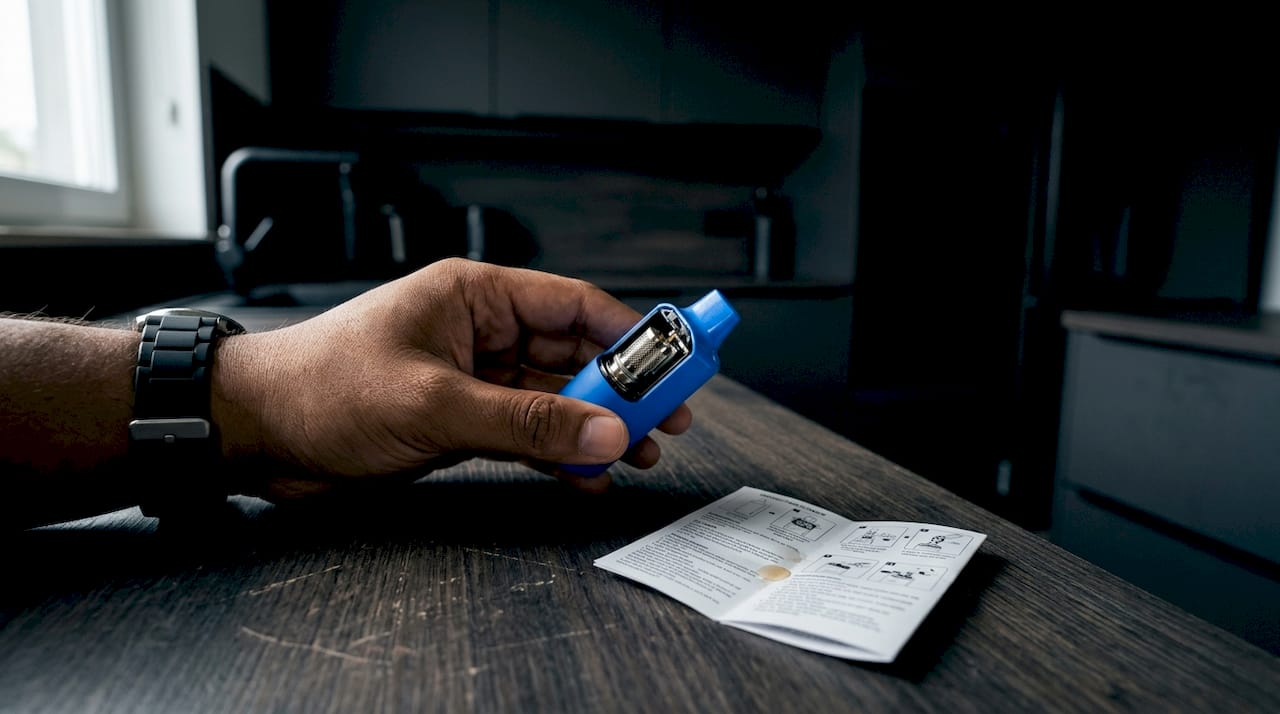
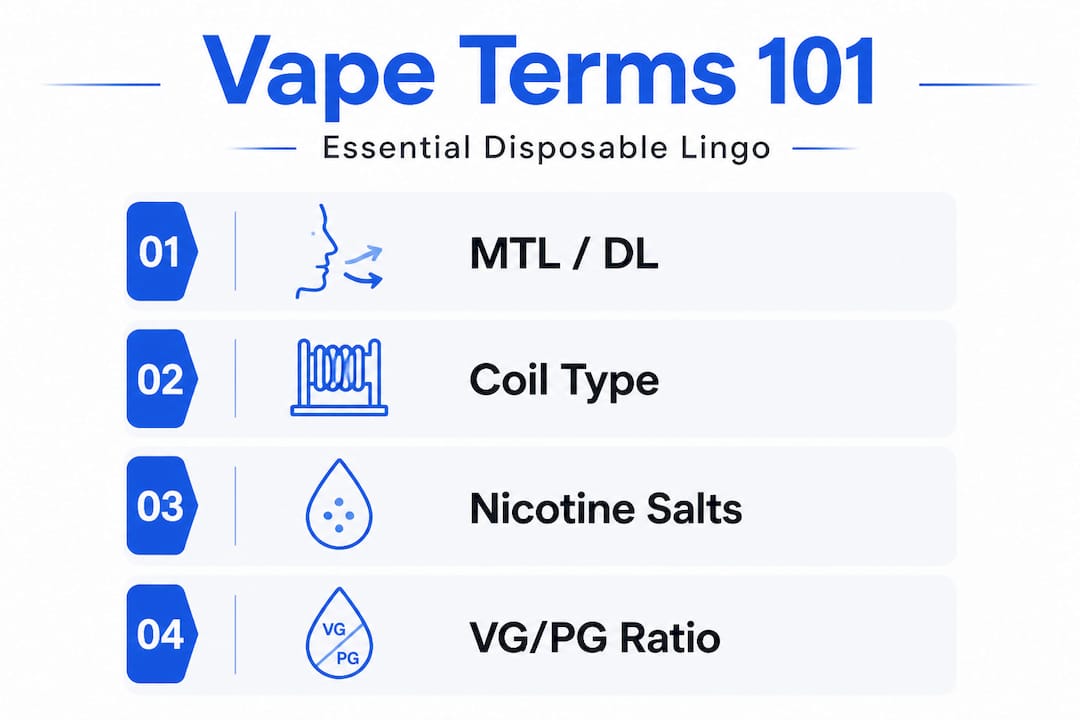
A coil is the heating element inside your vape. It consists of wire or mesh paired with a wick that absorbs e-liquid. When you draw, the coil heats up and vaporizes the liquid. Mesh coils specifically use a flat sheet with tiny holes, giving more surface area contact with the wick. More contact means more even heating, which translates to consistent flavor from your first puff to your last.
MTL vs. DL
MTL (mouth-to-lung) means vapor goes into your mouth first, then you inhale it into your lungs. This style has a tighter draw and typically uses high nicotine salt concentrations. It mimics the feel of smoking a cigarette. Direct lung (DL) means you inhale vapor directly into the lungs in one motion, like a deep breath. DL produces bigger clouds and uses lower nicotine levels.
Almost all disposable vapes are tuned for MTL use. If you see a device marketed for a tight draw or smooth hit, it’s MTL.
Nicotine salts
Nicotine salts use benzoic acid to stabilize nicotine at higher concentrations without the harsh throat hit that comes with freebase nicotine at the same strength. This makes them ideal for disposables where 30mg or 50mg concentrations are standard. The result is a fast-acting, satisfying hit that doesn’t burn.
VG/PG ratio
VG (vegetable glycerin) and PG (propylene glycol) are the two carrier liquids in e-liquid. VG creates thicker vapor and a smoother texture. PG carries flavor more efficiently and provides a stronger throat hit. Disposables typically use a high VG formula to maximize vapor production while maintaining smoothness.
| Term | What it means | Impact on experience |
|---|---|---|
| MTL | Mouth-to-lung draw | Tight, cigarette-like feel |
| DL | Direct lung inhale | Open, airy, bigger clouds |
| Nicotine salts | Stabilized nic formula | Smooth, high-strength hit |
| Freebase nicotine | Standard nicotine | Harsher at high concentrations |
| High VG | More vegetable glycerin | Smoother, thicker vapor |
| High PG | More propylene glycol | Stronger throat hit, sharper flavor |
Draw-activated vs. button-activated
Draw-activated devices fire automatically when you inhale. No buttons, no settings. Button-activated devices require you to press and hold a button while you puff. Disposables use draw activation almost universally. If you’re switching from a button-activated pod system, this shift takes one or two draws to get used to.
Pro Tip: If your disposable feels like vapor production drops off mid-session, take slightly shorter draws. Longer pulls can flood the coil, reducing output efficiency, especially in high-VG formulas.
For a device with excellent mesh coil performance, the Watermelon Ice pod is a clear example of how these terms come together in a single product.
With these basics clear, let’s dive into the more technical terms you’ll see on packaging and specs — and what they mean for you.
Technical vape vocabulary: Wattage, Ohms, and device mechanics
These are the numbers behind the performance. You won’t adjust them on a disposable, but knowing what they mean helps you understand why one device feels different from another.
Wattage (W)
Wattage is the power delivered to the coil. Higher wattage produces warmer vapor and vaporizes e-liquid faster. This increases intensity but also depletes the device more quickly. In disposables, the wattage is fixed at the factory level. You don’t set it. But when you see a device described as producing “warm vapor” or “cool vapor,” that describes where its fixed wattage sits on the spectrum.
Ohms (Ω)
Ohms measure the electrical resistance of the coil. Lower resistance means more current flows through the coil, producing more heat and vapor. Higher resistance produces a cooler, more restricted draw. MTL disposables typically use coils rated 0.8 to 1.2Ω and operate between 8 and 20 watts with nicotine concentrations of 10 to 20mg (or higher with salts). DL devices use sub-ohm coils below 1.0Ω.
Battery and sensor mechanics in disposables
The internal mechanics of a disposable are specifically engineered for consistency. According to how disposable devices work, these devices rely on a fixed low-output battery, a micro-coil, capillary wick feed, and a draw sensor, all tuned to deliver consistent MTL puffs until depletion. The draw sensor detects airflow and triggers the battery automatically. There’s no variable voltage. No power adjustment. This is intentional: consistency is the goal.
Here’s how the core specs connect to what you actually experience:
- Fixed wattage = predictable warmth. You know every puff will feel the same from draw one to draw five hundred.
- Capillary wick feed = no dry hits early on. The wick continuously draws liquid to the coil as long as e-liquid remains.
- Draw sensor = hands-free activation. No button fiddling. Just inhale.
- Micro-coil = compact heat source. Designed specifically for the small form factor of disposables without sacrificing vapor quality.
| Spec | Typical disposable value | What it means for you |
|---|---|---|
| Coil resistance | 0.8 to 1.2Ω | Moderate heat, MTL draw |
| Wattage | 8 to 20W (fixed) | Consistent warmth |
| Nicotine concentration | 30 to 50mg nic salts | Satisfying without harshness |
| Activation | Draw sensor | Auto-fires on inhale |
| Battery | Fixed capacity | No recharging for standard units |
Pro Tip: When comparing two disposables with different puff counts, consider that the higher-count device likely uses a higher-capacity battery and more e-liquid. It isn’t the same device running longer. Check if the flavor profiles hold up across the full puff range before committing to a new brand.
The VUE 50K Kit Miami Mint and Frozen Strawberry Pulse are both strong examples of devices where these technical specs translate into a clearly defined experience from first puff to last.
Armed with this knowledge, you’re ready to apply it when choosing and using disposables.
Applying vape terminology to your disposable vape choices
Knowing the terms is only useful if you apply them when you make decisions. Here’s how to use this vocabulary in practice.
Choosing based on draw style and nicotine preference
If you’re transitioning from cigarettes, look specifically for MTL-rated devices with nicotine salts at 30mg to 50mg. Nicotine salts are smoother at high strengths and satisfy nicotine cravings faster than freebase options. This combination most closely replicates the physical and nicotine experience of smoking.
If you’re already comfortable with vaping and want bigger clouds with lower nic, look for devices with DL draws and sub-ohm coils. These are less common in disposables but exist in larger form-factor products.
Matching VG/PG ratios to your preference
If you want dense, visible vapor and a smooth hit, prioritize high VG formulas (70% VG or higher). If you want sharper flavor and a stronger throat hit, a higher PG ratio delivers that. Most disposables default to high VG, but some brands publish their exact ratios. When they don’t, “smooth” usually signals high VG, while “strong throat hit” signals higher PG.
Troubleshooting common issues using terminology
- Weak vapor output: The coil may be underpowered for the viscosity of the e-liquid. High-VG formulas are thick. If vapor feels thin early in the device’s life, the wick may not be fully saturated. Take a few short draws to prime it.
- Harsh throat hit: This often points to a high-PG formula, or freebase nicotine at a high concentration. Switch to a nicotine salt formula or a lower PG ratio product.
- Burnt taste: The wick has dried out. This happens near the end of the device’s life or from chain vaping without pause. The capillary wick can’t keep up with rapid consecutive draws.
- Inconsistent vapor between draws: The draw sensor may have a sensitivity threshold. If your inhale is too shallow, it won’t activate fully. Take a steady, consistent pull.
The Raspberry Watermelon Thermal Edition is a product where draw-activated technology and nicotine salt formulation are both working in tandem to deliver a specific experience. Knowing the terminology lets you understand exactly why it performs the way it does.
Pro Tip: If you’ve bought a disposable and the draw feels too tight or too loose for your preference, that’s not a defect. It’s a design choice reflected in the coil resistance. Use that experience as data for your next purchase.
What most guides miss: The reality of disposables and terminology
Most vape terminology guides treat definitions as an endpoint. Define the word, move on. That approach misses the practical value entirely.
Here’s what we’ve observed: disposable vape users who understand terminology don’t just make better purchases. They stop chasing the “perfect vape” indefinitely because they know what to look for from the start. They understand that a disposable’s mechanics are intentionally constrained. You’re not supposed to tune them. The manufacturer already did that work.
The spec sheet on a disposable is not an invitation to modify anything. It’s a description of what the device will consistently do. When you understand wattage, coil resistance, nicotine type, and VG/PG ratios as a connected system rather than isolated numbers, you stop being surprised by your vaping experience and start predicting it.
There’s also a safety dimension most guides skip. Disposables contain both a battery and a nicotine delivery system. Understanding how the draw sensor and battery interact means you recognize warning signs, like a device that fires without being drawn on, or one that gets unusually warm. These are mechanical issues, not just annoyances, and knowing the underlying terms helps you describe problems accurately.
The best disposable vapers we see at Cloud District are not the ones with the most gear. They’re the ones who can walk in, state exactly what draw style they prefer, what nicotine level works for them, and what flavor profile they want. That comes directly from understanding terminology. Every piece of knowledge you pick up from a guide like this shortens the path from “I’m not sure” to “this is exactly right.”
Find your perfect disposable vape with Cloud District
Knowing your terminology makes browsing disposables far more efficient. You know your draw style. You know your preferred nicotine concentration. You know whether you want smooth high-VG vapor or a sharper throat hit. Now you can apply all of that when you shop disposables at Cloud District.

Cloud District carries a curated range of top-tier disposable brands, including Geek Bar and Pulse X, all pre-selected for quality and consistency. Products like the VUE 50K Kit Miami Mint and Pulse Strawberry Savers represent exactly the kind of well-specced, flavor-forward devices your new terminology knowledge was built to evaluate. Every purchase earns Cloudz rewards points, and the streamlined pickup model means your next device is ready fast. Use what you’ve learned and shop with confidence.
Frequently asked questions
What does MTL mean for disposable vapes?
MTL (mouth-to-lung) describes a draw style where vapor enters the mouth first and then goes into the lungs, using a tight draw with high nicotine salts for a satisfying, cigarette-like inhale that is standard across most disposables.
How does wattage affect disposable vape performance?
Higher wattage delivers warmer vapor and burns through e-liquid faster, but in disposables the wattage is factory-fixed for consistent output, so the device performs the same on every draw until the battery or e-liquid is depleted, as confirmed by how disposable mechanics work.
What is the difference between nicotine salts and regular nicotine?
Nicotine salts are formulated to be significantly smoother at high concentrations, making them the standard choice for MTL disposable devices, while freebase nicotine at similar strengths produces a noticeably harsher throat hit.
What does VG/PG ratio mean in disposables?
VG produces thicker clouds and a smoother texture while PG sharpens flavor and increases throat hit intensity. Most disposables use a high-VG formula to maximize vapor consistency and smoothness across the entire device lifespan.
How are draw-activated vapes different from button-activated?
Draw-activated vapes fire the coil automatically through an airflow sensor the moment you inhale, which is the standard design for virtually all disposable vapes, as opposed to button-activated systems that require manual input to produce vapor.