What Is a Zero Nicotine Vape? Your 2026 Guide

What Is a Zero Nicotine Vape? Your 2026 Guide
A zero nicotine vape is an electronic device that heats flavored e-liquid containing 0mg nicotine to produce vapor, delivering the full sensory experience of vaping without the addictive stimulant. The industry term for these products is “nicotine-free vapes,” though “zero nicotine” is widely used by consumers and retailers alike. These devices use a base of vegetable glycerin (VG) and propylene glycol (PG) combined with food-grade flavorings. They mimic the vaping ritual without delivering nicotine to the bloodstream. Common formats include disposable pre-filled vapes, refillable pod systems, and aromatherapy diffusers.
What is a zero nicotine vape and how does it work?
A zero nicotine vape operates on the same basic principle as any vape device. A battery-powered heating element warms the e-liquid until it becomes an inhalable aerosol. The difference is the e-liquid itself: 0mg nicotine content means no stimulant enters the body with each puff.
The vapor production process relies on VG and PG as carrier liquids. VG produces thick, visible clouds. PG carries flavor more effectively and provides a mild throat sensation. Most nicotine-free e-liquids blend both to balance cloud volume and flavor clarity.
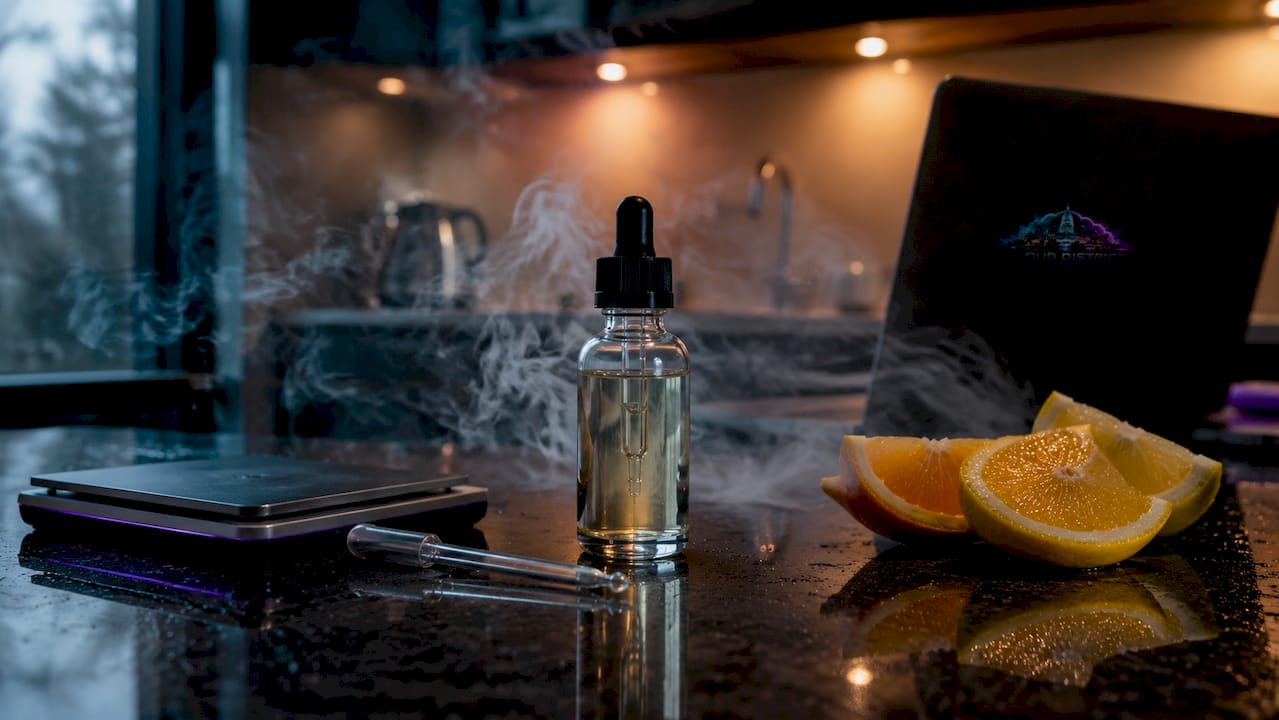
One thing many people do not expect: the throat hit is noticeably weaker in zero nicotine vapes. Nicotine itself creates that sharp sensation at the back of the throat. Without it, the experience feels smoother but less intense. Some manufacturers add additives to mimic throat hit, though the safety of these additives remains unverified.
Types of nicotine-free vapes
| Type | Main ingredients | Best use |
|---|---|---|
| Disposable pre-filled vape | VG, PG, food-grade flavorings | Convenience, flavor sampling |
| Refillable pod system | User-selected 0mg e-liquid | Cost savings, customization |
| Vitamin-infused vape | VG, PG, B12 or other supplements | Wellness-oriented users |
| Aromatherapy diffuser | Essential oils, no e-liquid | Scent therapy, non-inhalation use |
Various formats serve different goals, from quitting nicotine to flavor enjoyment to wellness routines. Aromatherapy diffusers sit at the far end of the spectrum: they use essential oils rather than e-liquid and are not designed for lung inhalation.
Pro Tip: If you are new to nicotine-free vaping, start with a disposable device to test flavors before investing in a refillable pod system.
What are the health impacts of zero nicotine vaping?
Zero nicotine vaping removes several well-documented risks tied to nicotine. Nicotine raises heart rate, strains the cardiovascular system, disrupts brain development in younger users, and creates chemical dependency. Removing it eliminates those specific harms.
The remaining risks come from the act of inhalation itself. Nine key studies link non-nicotine aerosol inhalation to endothelial dysfunction and arterial stiffness. That means even vapor without nicotine can affect blood vessel health over time.
“No vape is truly safe. The long-term effects of inhaling heated carbon-based chemicals remain largely unknown and may harm airway health.” — Pulmonologist Dr. Angela Wang, Cleveland Clinic
Inhaling aerosolized volatile organic compounds, even from flavored e-liquids with no nicotine, may cause mild respiratory irritation and oxidative stress. Switching to nicotine-free vaping removes the major known health risks but does not eliminate all of them.
| Health factor | Nicotine vape | Zero nicotine vape |
|---|---|---|
| Chemical addiction | Yes | No |
| Heart rate increase | Yes | No |
| Brain development risk | Yes | No |
| Endothelial dysfunction | Yes (higher risk) | Possible (lower risk) |
| Respiratory irritation | Yes | Mild, possible |
| Oxidative stress | Yes | Mild, possible |
| Long-term airway effects | Documented | Under ongoing research |
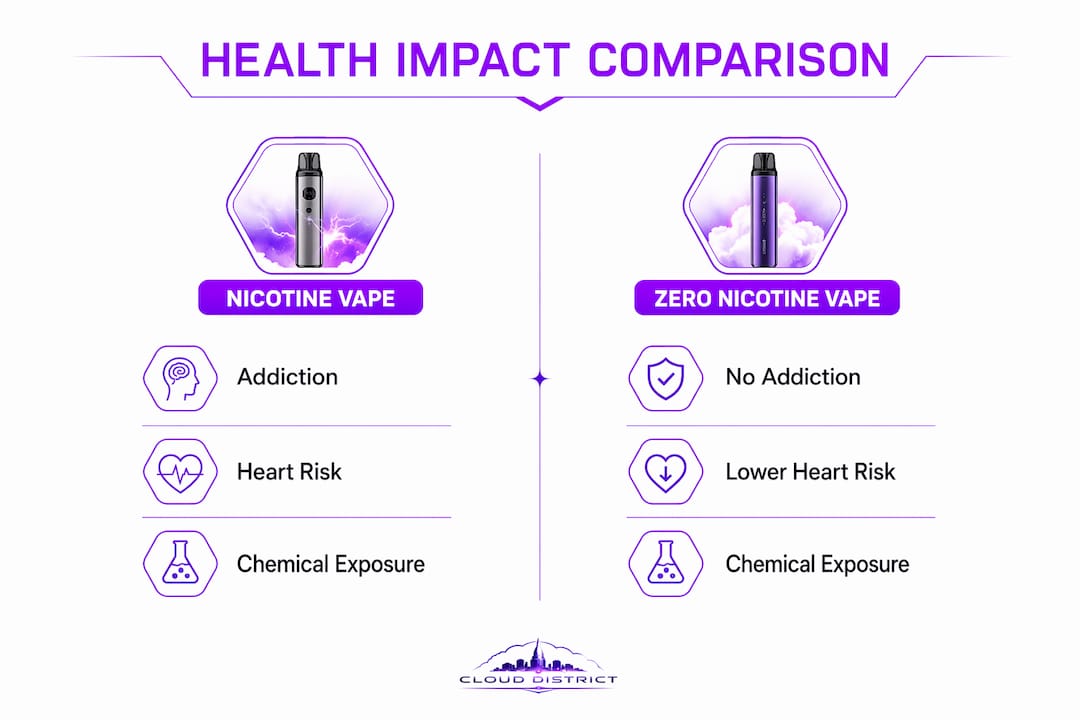
The table above shows a clear reduction in risk profile, not an elimination of risk. That distinction matters for anyone treating zero nicotine vaping as a completely safe activity.
How does zero nicotine vaping affect behavior and habits?
Zero nicotine vaping removes chemical dependency but preserves the behavioral routine. That is a meaningful distinction. Chemical addiction to nicotine is one problem. Habitual, ritual-driven behavior is another, and the two do not disappear together.
Behavioral dependency from the hand-to-mouth action, the inhale-exhale rhythm, and the sensory feedback of flavor and vapor can sustain vaping independently of nicotine. Users who switch to zero nicotine products often find the habit persists because the ritual itself is rewarding.
The missing throat hit complicates this further. Many users find the smoother experience unsatisfying. Some turn to unregulated additives that attempt to reproduce the throat hit sensation, but these carry unknown health and addiction risks.
Breaking habitual use requires intentional effort beyond simply removing nicotine from the product. Here are the behavioral effects to be aware of:
- Ritual reinforcement. The hand-to-mouth action and breathing pattern become conditioned responses that persist without nicotine.
- Flavor reward loops. Enjoyable flavors create positive associations that encourage repeated use.
- Social habit maintenance. Vaping in social settings reinforces the behavior regardless of nicotine content.
- Throat hit dissatisfaction. The absence of nicotine’s throat hit may push users toward additives or higher vapor output settings.
- Reduced urgency to quit. Perceiving zero nicotine vaping as safe can reduce motivation to stop vaping altogether.
Pro Tip: Set a daily puff limit and track your usage for two weeks. Behavioral patterns become visible quickly, and visibility is the first step toward changing them.
How to choose zero nicotine vape products safely
Product quality varies significantly across the zero nicotine vape market. The most important factor is manufacturer transparency. A reputable brand publishes its ingredient list, VG/PG ratio, and third-party lab results. If that information is not publicly listed, the product warrants caution.
Regulatory oversight is a real gap in this category. Zero nicotine vapes often fall outside FDA tobacco product regulations, which means labeling standards are inconsistent. Some products labeled “0mg nicotine” have tested positive for trace nicotine amounts. Verifying through lab-tested brands reduces that risk significantly.
Choosing the right device type depends on your goal. If you are stepping down from nicotine vaping, a refillable pod system with a familiar form factor makes the transition easier. If you want to explore vape flavors without commitment, a disposable is the practical starting point. For wellness-oriented use, vitamin-infused formats offer an alternative, though their health claims are not uniformly validated.
- Verify that the brand publishes third-party lab results for nicotine content and ingredient safety.
- Check that the product complies with applicable state and local regulations, which vary widely.
- Avoid products with vague ingredient lists or no manufacturer contact information.
- Read the counterfeit vape risks before purchasing from unfamiliar sources.
- Choose a device format that matches your goal: disposable for sampling, refillable for regular use.
- Consult a beginner’s vape guide if you are new to selecting devices and e-liquids.
Legal compliance also matters for retailers. The 2026 vape compliance landscape includes state-level restrictions on flavored products and age verification requirements that apply even to nicotine-free items in many jurisdictions.
Key Takeaways
Zero nicotine vapes reduce chemical addiction risk significantly, but behavioral dependency and aerosol inhalation risks remain real concerns that require informed, deliberate management.
| Point | Details |
|---|---|
| Core definition | A zero nicotine vape heats 0mg nicotine e-liquid to produce vapor without delivering the addictive stimulant. |
| Reduced but not zero risk | Removing nicotine eliminates cardiovascular and addiction harms, but aerosol inhalation still poses mild vascular and airway risks. |
| Behavioral dependency persists | Ritual, flavor, and sensory feedback sustain habitual use even without chemical addiction. |
| Product quality varies widely | Many zero nicotine vapes fall outside FDA oversight, making manufacturer transparency and lab testing critical. |
| Match device to your goal | Disposables suit flavor sampling; refillable pods suit regular use; vitamin-infused formats serve wellness-oriented consumers. |
Why I think zero nicotine vaping is misunderstood on both sides
People tend to land in one of two camps on zero nicotine vaping: they treat it as completely safe, or they dismiss it as pointless. Both positions miss the reality.
The harm reduction case is legitimate. Removing nicotine from the equation eliminates addiction, cardiovascular strain, and brain development risk. For someone stepping down from heavy nicotine use, that is a meaningful improvement. The research on aerosol inhalation risks is real, but the risk level is materially lower than nicotine vaping.
What I find underappreciated is the behavioral side. Most conversations focus on the chemistry. The habit loop gets far less attention. Someone who switches to zero nicotine and still vapes 200 times a day has not solved the underlying problem. They have changed the substance but not the behavior. That matters, and it deserves honest acknowledgment.
The other thing worth saying plainly: the regulatory gap is a consumer protection problem. When products labeled “0mg nicotine” sometimes contain nicotine, and when manufacturers are not required to disclose full ingredient lists, the consumer carries the risk. Buying from transparent, lab-tested brands is not optional caution. It is the minimum standard for responsible purchasing.
Zero nicotine vaping is a tool. Like any tool, its value depends entirely on how it is used and whether the user understands what it actually does.
— Justin
Cloud District’s zero nicotine vape options
Cloud District carries a curated selection of zero nicotine vapes built for flavor quality and product transparency. Whether you are stepping down from nicotine or simply want the vaping experience without the stimulant, the options below are worth considering.

The Pulse Strawberry Kiwi Thermal Edition delivers a clean, fruit-forward profile in a disposable format that requires no setup. For something with more edge, the RIA Sour Strawberry Dragon combines tart and sweet in a satisfying draw. Cloud District’s Cloudz rewards program applies to every purchase, so each order builds toward your next deal. All products are available for local pickup through the platform, with age verification required at purchase for all customers 21 years or older.
FAQ
What is a zero nicotine vape made of?
A zero nicotine vape contains vegetable glycerin (VG), propylene glycol (PG), and food-grade flavorings with 0mg nicotine. No tobacco-derived ingredients are present in a properly formulated nicotine-free e-liquid.
Is a nicotine-free vape completely safe?
No. Removing nicotine eliminates addiction and cardiovascular risks, but inhaling aerosolized chemicals can still cause mild respiratory irritation and possible vascular effects. No vape product is risk-free.
Can you get addicted to a zero nicotine vape?
Chemical addiction to nicotine is not possible with a 0mg product, but behavioral dependency from the ritual, flavor, and sensory feedback can sustain habitual use independently of any chemical.
How does a zero nicotine vape differ from a regular vape?
The only formulation difference is the absence of nicotine in the e-liquid. The device mechanics, vapor production, and flavor delivery work identically. The experience feels smoother due to the missing throat hit that nicotine normally provides.
Are zero nicotine vapes regulated by the FDA?
Many zero nicotine vapes fall outside standard FDA tobacco product regulations, which creates inconsistent labeling and ingredient disclosure. Consumers should prioritize brands that publish third-party lab results to verify nicotine content and ingredient safety.